Ever had a Taxpayer Identification Number (NPWP) but just realized you haven't filed your Annual Tax Return (SPT) for years?
This situation often triggers panic for many people. Most business owners and employees think that tax obligations only involve paying a sum of money. In fact, filing an SPT is an administrative obligation separate from tax payment.
Even if your business has no turnover, is in Nihil status, or you are not working, the obligation to report your Annual SPT remains as long as your NPWP is active. So, if SPTs have piled up and been missed for years, can they still be filed? How much is the fine, and what is the settlement mechanism? See the guide below.
Reporting Deadline and Late Filing Fines
Based on the provisions of the Law on General Provisions and Tax Procedures (UU KUP) Article 7, the deadline for filing Annual Income Tax Returns is:
- Individual Taxpayers: At the latest 3 months after the end of the Tax Year (generally March 31)
- Corporate Taxpayers (PT/CV): At the latest 4 months after the end of the Tax Year (generally April 30)
Administrative Sanctions for Late Filing
If that deadline is missed, the DJP imposes administrative fines for late submission of SPT:
- Individual Taxpayers: IDR 100,000 per SPT per tax year
- Corporate Taxpayers (PT/CV): IDR 1,000,000 per SPT per tax year
Important Note: The fines above are sanctions for late filing (administrative). If, upon recalculating the SPT, an underpayment is found (Income Tax Article 29), then a residual Tax Interest sanction will arise, calculated based on the DJP's monthly reference interest rate.
Consequences of Forgetting to File SPT: Can It Be Criminally Charged?
Many people worry about being immediately criminally prosecuted for forgetting to file SPT for years. Legally, forgetting or not understanding the procedure does not automatically make someone criminally liable.
The imposition of criminal tax sanctions (according to UU KUP) requires proof of an element of intent that significantly harms state revenue. However, letting SPT remain overdue for years still risks causing administrative problems, such as:
- Issuance of Tax Assessment Letters (STP) for late fines accumulated.
- Difficulty in managing business licenses, such as NIB (Business Identification Number) or PKP confirmation.
- Issuance of a Letter Requesting Explanation for Data and/or Information (SP2DK) from the Tax Service Office (KPP).
Steps to Mitigate and Resolve Overdue SPT
To ensure the settlement of overdue taxes runs smoothly without fatal errors, follow these systematic steps:
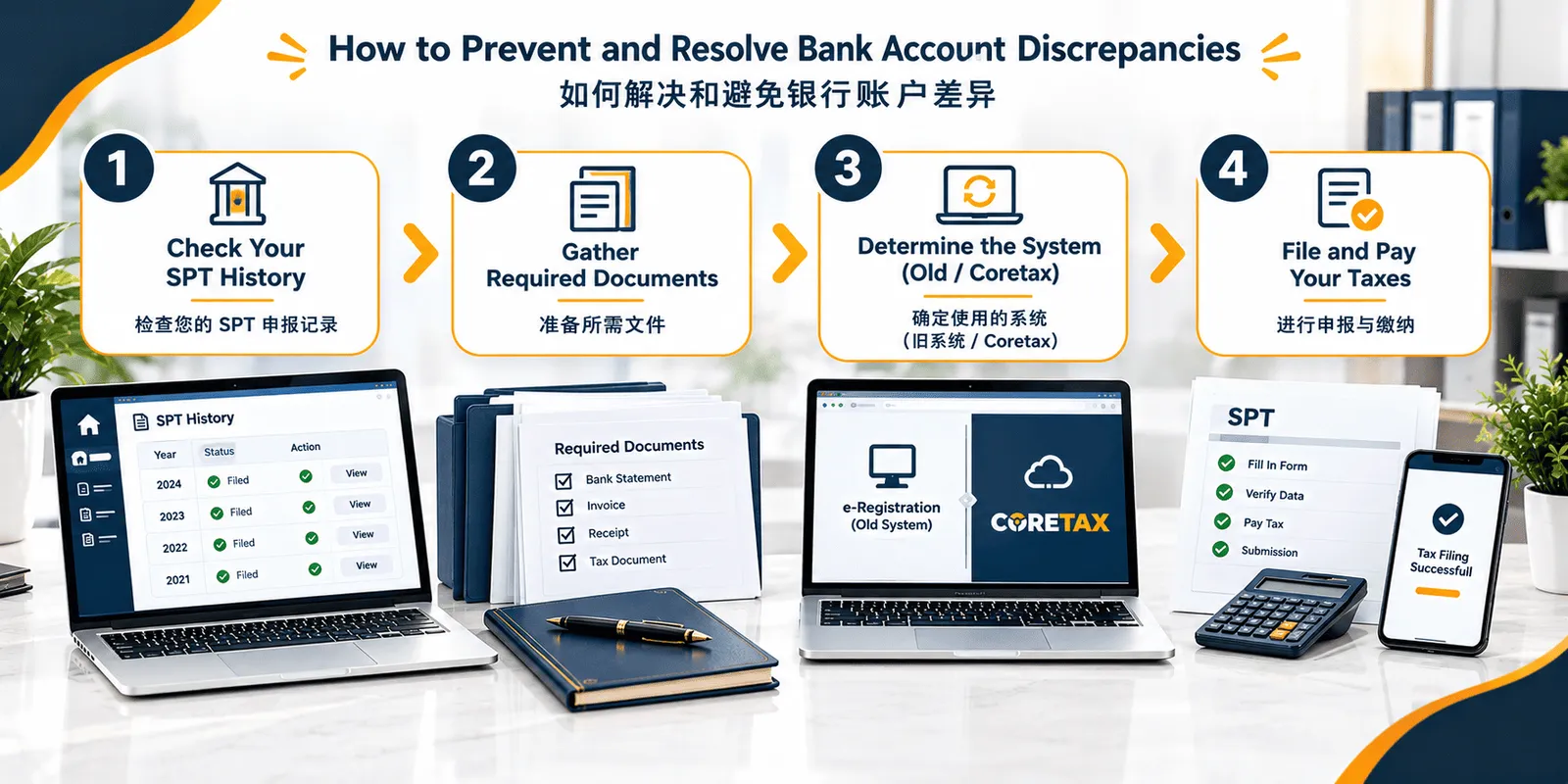
Do not immediately create a new SPT. Log in to the DJP Online portal or contact your registered KPP to check which tax years have not been submitted. This is important to prevent duplicate reporting.
Step 2: Gather documents according to the relevant tax year
Prepare supporting documents according to each tax year period, including:
- Employees: Withholding Evidence 1721-A1/A2 from the employer in that year.
- Business Owners / Freelancers: Monthly turnover records, asset/property lists, debt lists, and proof of Final Income Tax payment.
- Corporate Entities (PT/CV): Financial Statements (Balance Sheet and Profit & Loss) for the relevant year and Company Deed Amendment data if there were changes in management composition.
Step 3: Note the Difference in Reporting Systems (Old System vs DJP Coretax)
Tax reporting procedures are adjusted according to the tax year period:
- SPT for Tax Year 2024 and Earlier: Filled and reported through the DJP Online e-Form portal/application of the old system (including for Normal or Amendment status).
- SPT for Tax Year 2025 and Onwards: Filled and completed using the integrated DJP Coretax system.
Step 4: Settle Underpayment and Save the BPE
If the SPT results show an Underpayment status, make the payment via the e-Billing code first before submitting the report. After the report is sent, save the Electronic Receipt Proof (BPE) as an archive of legal compliance evidence.
What If You Are No Longer Working or the Business Has Closed?
Stopping work or closing business operations does not automatically erase the obligation to report SPT for previous years.
If in the future you no longer have income or the business has officially ceased:
- For Individuals: After settling the overdue SPT, you can apply for Non-Effective Taxpayer (NE) status determination.
- For Corporate Entities (PT/CV): If the PT has ceased operations but has not been dissolved by deed, carry out the NE status determination process or official dissolution process before applying for NPWP revocation.
FAQ About Overdue SPT
Must the late filing fine be paid before filing the SPT?
Not necessarily. You can file the overdue Annual SPT first. The Tax Assessment Letter (STP) for the late fine will be officially issued by the registered KPP afterwards.
What if the withholding evidence or tax documents from past years are lost?
You can request a copy of the Withholding Evidence from the employer/tax withholder, or consult with the Assessor/Account Representative (AR) at the registered KPP to match historical data recorded in the DJP system.
Organize Your Tax Compliance and Business Legality with Awan Kusuma Legalitas
Settling years of overdue SPT and correcting tax data requires precision so as not to cause miscalculations that trigger SP2DK. The Awan Kusuma Legalitas team is ready to provide professional assistance to help compile, organize, and report all corporate and individual tax obligations in an orderly and regulation-compliant manner.
We are ready to help process all your business legality and compliance needs comprehensively. Starting from legal entity registration via PT Establishment andSole Proprietorship PT Establishment, business licensing through NIB, PKP status confirmation, to organizing Annual SPT reporting. Together with us, your business administration and tax settlement is guaranteed to be calm, orderly, and transparent.
Want to consult about settling overdue Annual SPT or tidying up your company's tax administration? Contact the Awan Kusuma Legalitas Team via WhatsApp now for an integrated consultation session!