Establishing a business entity in the form of a Limited Liability Company (PT) is a crucial first step in building a business legacy. However, not a few business owners face a waiting period after the establishment documents are completed, whether due to still processing subsequent permits, preparing operational locations, or responding to market dynamics.
Amid these conditions, a very frequently asked question arises: If a PT is not yet operating and has no turnover, is the company still required to file taxes?
The answer is YES, STILL REQUIRED. Many beginner entrepreneurs fall into the misconception that tax obligations only arise after the business starts generating revenue. This article will thoroughly discuss the legal basis, the concept of a Zero SPT, and the administrative consequences that every PT owner must know.
What Is Meant by a Company Not Yet Operating?
A company that is not yet operating is a business entity that has been legally established and holds a Taxpayer Identification Number (NPWP), but has not yet carried out commercial operational activities. This means the PT has not recorded any sales, has not received income, and has not generated profits.
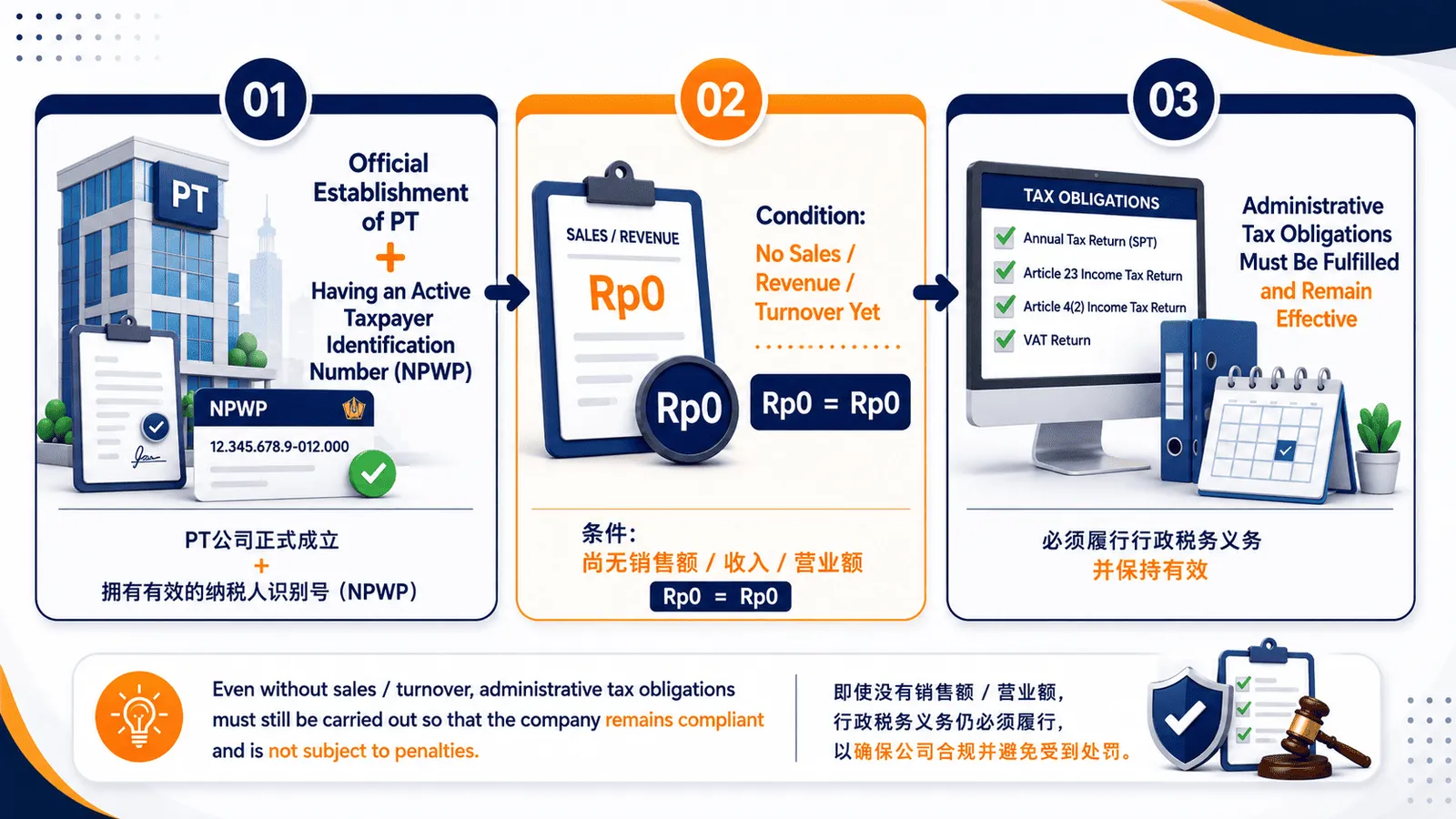
It is important to understand that the status of "not yet operating" does not automatically freeze the company's administrative obligations. As long as the PT's NPWP status is active, the Directorate General of Taxes (DJP) still records your company as a Corporate Taxpayer bound by periodic reporting provisions.
Annual SPT Reporting Obligation for New PTs
The obligation to submit an Annual Tax Return (SPT) is not determined by the presence or absence of company turnover. The main parameter lies in the status of having an active Corporate NPWP.
Illustrative Example:
PT Sinar Terang Jaya was officially established in January 2026, but full business operations are only planned to commence in 2027. Even though throughout 2026 the company had no sales or income whatsoever, PT Sinar Terang Jaya is still required to submit its Annual SPT for the 2026 Tax Year.
In addition to the Annual SPT, the company is also required to pay attention to monthly tax obligations. If the PT has employed workers or provides compensation to the board of directors, the company has an obligation to withhold, deposit, and report PPh Article 21, even if the main business activities have not yet generated revenue.
Understanding the Concept of Zero SPT
For entities that are not yet operating, the type of report submitted is generally in the form of a Zero SPT.
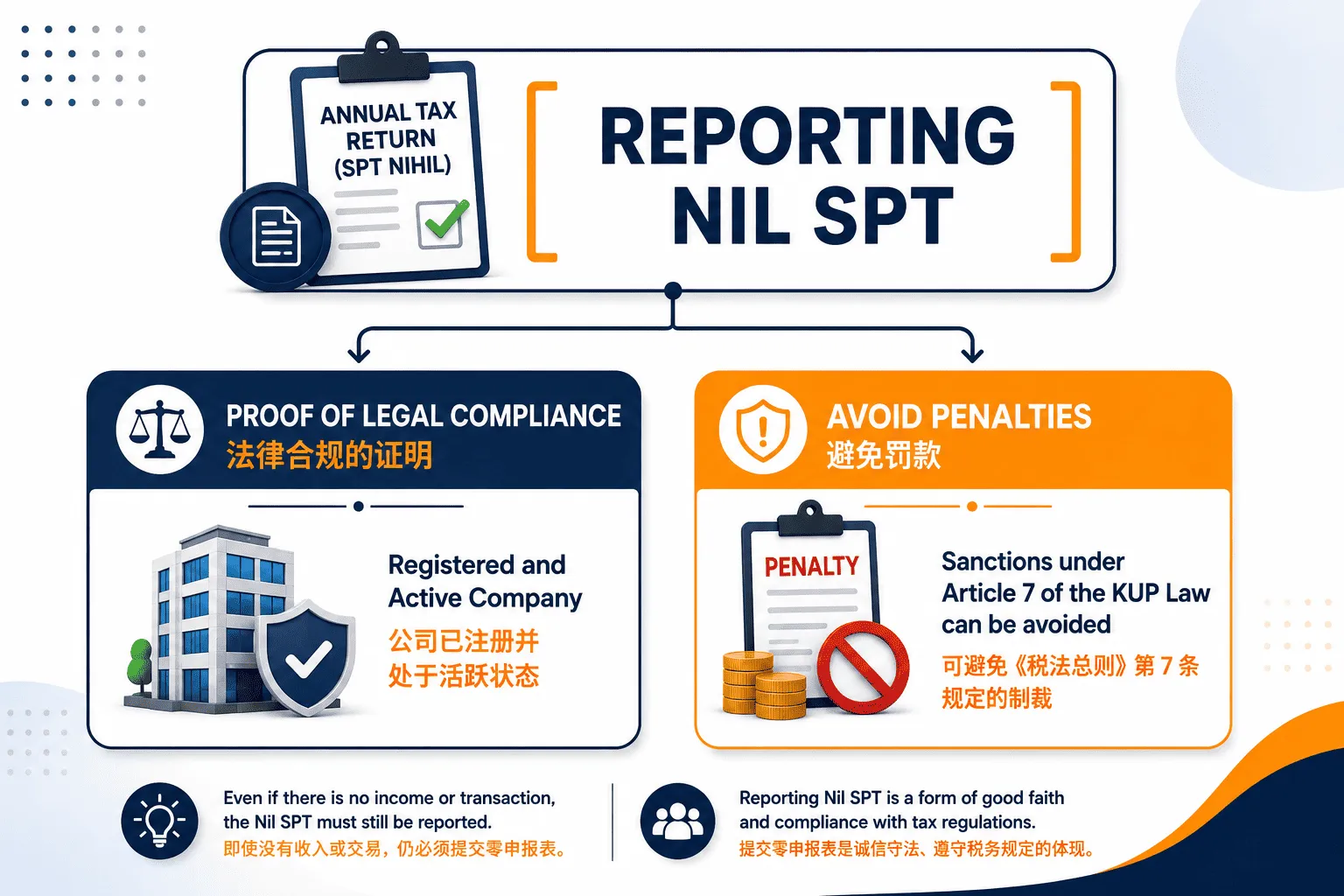
A Zero SPT is a tax report submitted when the company has no tax payable or due. Through the Zero SPT, the company officially notifies the tax authorities that the PT's existence remains active but has not yet recorded financial activities that generate tax liabilities.
When Does a PT Start Being Required to Pay Taxes?
It is important to distinguish between the obligation to report and the obligation to pay:
- Reporting Obligation: Arises from the moment the Corporate NPWP is issued.
- Payment Obligation: Arises when the company has conducted commercial transactions, received taxable income, or meets the requirements as a PKP (Taxable Entrepreneur).
Therefore, you do not need to worry about having to allocate a budget to pay income tax as long as the business has not yet generated turnover. The most important thing is consistency in submitting reports.
Consequences of Ignoring Annual SPT Reports
Neglecting reporting obligations can bring various negative impacts that disrupt business stability in the future:
- Administrative Penalty Fines: Under Article 7 of the General Provisions and Tax Procedures Law (UU KUP), delays or failure to submit the Corporate Taxpayer Annual SPT are subject to an administrative fine of IDR 1,000,000 per tax year.
- Banking Administrative Obstacles: When the company intends to apply for capital loans or open additional business accounts, the bank will check tax compliance through a Tax Clearance or KSWP.
- Compliance Profile Disrupted: A poor tax history can trigger stricter supervision from the local tax office (KPP).
Common Tax Mistakes of New PTs
Some errors often made by beginner company founders include:
- Assuming No Turnover Means No Reporting Obligation: Ignoring the Annual SPT simply because there have been no sales transactions.
- Delaying Bookkeeping: Not maintaining financial records from the very first day of establishment. In fact, pre-operational expenses must be properly recorded.
- Disorganized Document Storage: Failing to archive legal documents and transaction evidence in a structured manner.
Tips for Maintaining Tax Compliance Before Operations
To ensure your business runs smoothly without tax-related obstacles, apply the following anticipatory steps:
- Note Reporting Deadlines: The Corporate Taxpayer Annual SPT reporting deadline is no later than April 30 each year.
- Organize Legal Archives: Store establishment deeds, Ministry of Law and Human Rights Decree, NPWP, NIB, and supporting permits in one dedicated folder.
- Start Simple Bookkeeping: Record every capital contributed and the company's initial expenses.
- Use Professional Assistance: If the board of directors is focused on business operational preparation, entrust tax administration management to experienced consultants.
FAQ About Taxes for PT Not Yet Operating
Is a PT that is not yet operating but has employees required to file taxes?
Yes. If the company pays salaries or compensation to employees or management, there is an obligation for periodic withholding and reporting of PPh Article 21.
What is the fine if a PT does not report its Corporate Annual SPT?
According to the UU KUP, the fine for late or non-reporting of the Corporate Taxpayer Annual SPT is IDR 1,000,000.
Can the NPWP status be temporarily deactivated if not yet operating?
The company can apply for Non-Effective Taxpayer status to the KPP if it meets certain criteria, but this requires a verification process from the tax authorities.
Tax Compliance Solutions with Awan Kusuma Legalitas
Managing tax compliance amidst the busyness of preparing business operations often consumes time and energy. Don't let administrative penalty fines damage the reputation of your newly established company.
The Awan Kusuma Legalitas consultant team is ready to help you manage all tax administrative obligations, from preparing initial bookkeeping, reporting Zero or Commercial Annual SPT, to fulfilling business licensing legality.
Your PT is already established but not yet operating and you are unsure about your tax obligations? Contact Us via WhatsApp now for a free consultation with the Awan Kusuma Consultant Team!