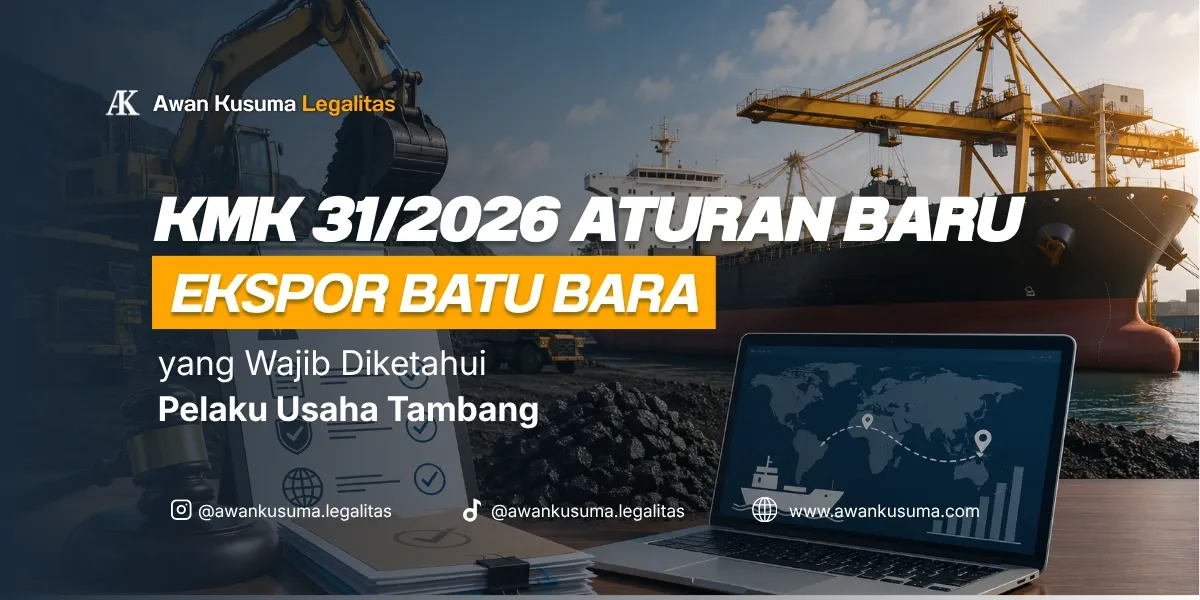
The government has officially tightened the supervision of strategic natural resource commodity governance in the country. Through Minister of Finance Decree KMK Number 31/MK/BC/2026, the Directorate General of Customs and Excise (DJBC) now has a new legal reference in overseeing the outflow of coal and its derivative products from the Indonesian customs territory.
This policy becomes a crucial instrument for the mining industry ecosystem. Every export business operator is required to understand the latest licensing mechanisms, fulfillment of legal documents, and the one-door export scheme that is being implemented gradually.
How does this regulation impact the operational legality of your company? Let's thoroughly examine the provisions below.
What Is KMK 31/2026?
KMK 31/2026 is a technical customs regulation governing the specific list of coal commodities subject to export restrictions. Established on May 31, 2026, and effective as of June 1, 2026, this regulation was issued to oversee the implementation of Minister of Trade Regulation (Permendag) Number 15 of 2026 concerning Policy and Regulation of Export of Strategic Natural Resource Commodities for Coal.
Through this guideline, Customs officers in the field have full authority to examine the validity of customs documents, conduct physical inspections at loading ports, and monitor the flow of goods in various special zones.
Legal Basis and Background of the Regulation Issuance
The issuance of KMK 31/2026 is part of the regulatory harmonization mandated by the central government. Its main legal basis refers to Government Regulation (PP) Number 24 of 2026 concerning Governance of Export of Strategic Natural Resource Commodities.
With the issuance of this new regulation, the previous provisions in KMK Number 24/MK/BC/2026 are officially revoked and declared invalid. This means that all current coal export procedures must now comply with the latest criteria and mechanisms.
Types of Coal Subject to Export Restrictions
According to the provisions of KMK 31/2026, a total of 16 types of coal and solid fuels are designated as restricted export goods. Commodities included in this list are classified based on Harmonized System (HS) Code Positions and Subpositions, including:
- Anthracite (very high-calorie coal).
- Bituminous Coal (including coking coal and fuel coal).
- Lignite (young/low-calorie coal).
- Peat and other types of solid coal.
These restrictions cover nearly the entire spectrum of internationally traded coal. Therefore, companies must ensure that the commodity classification registration in integrated foreign trade systems such as the INSW portal is aligned with the latest HS Codes.
Required Documents Before the Coal Export Process
To clear coal commodities from customs inspection, exporters are required to obtain two main documents:
1. Registered Exporter (ET) for Coal
An official certificate proving that the company has been registered as a valid exporter. For non-state-owned business entities, applying for Coal ET requires ownership of a legal mining license, such as an IUP Production Operation, IUPK, or PKP2B, and active registration in the Ministry of Energy and Mineral Resources system.
For entities experiencing business share adjustments or capital structure changes, license data updates must be carried out periodically through the Company Business Activity Change procedure.
2. Surveyor Report (LS)
A document of Verification or Technical Tracking results issued by an independent surveyor institution officially appointed by the Ministry of Trade to test the quantity and calorific specifications of the goods.
New One-Door Export Scheme Through PT DSI
One of the most crucial points in Permendag 15/2026 and KMK 31/2026 is the introduction of a one-door export scheme through a state-designated business entity, namely PT Danantara Sumberdaya Indonesia (PT DSI).
The government has established the following transition roadmap:
- Transition Period (Until December 31, 2026):
Companies holding Coal ET status are still permitted to export independently but are required to coordinate in an integrated manner with PT DSI regarding document reporting and sales contracts. - Full Implementation (Starting January 1, 2027):
All coal export transactions abroad must be carried out centrally through PT DSI's channel. Private mining companies may still produce, but the export distribution mechanism operates through PT DSI consolidation.
Expansion of Customs Supervision Channels
KMK 31/2026 not only tightens supervision at public ports but also expands the reach of Customs supervision to special ecosystem zones. Goods exit channels now fully supervised include:
- Goods release from Bonded Storage Areas.
- Goods release from Special Economic Zones.
- Goods release from Free Trade Zones and Free Ports.
Every release of coal commodities from these areas to outside the customs territory is still required to fulfill Coal ET documents and Surveyor Reports without exception.
Risks and Consequences of Non-Compliance
Failure of companies to meet the latest customs requirements can result in fatal operational obstacles. Incomplete export documents will be rejected by the Customs system, causing cargo detention at ports (demurrage costs) and even business license suspension sanctions.
Therefore, the readiness of basic licensing aspects such as having a validated NIB for the mining sector and data integration in the SIINAS system is a fundamental foundation that cannot be overlooked.
FAQ About KMK 31/2026 Regulations
What is the main difference between KMK 31/2026 and Permendag 15/2026?
Permendag 15/2026 regulates general export trade policy, while KMK 31/2026 is a technical operational regulation for Customs to inspect and supervise goods in the field.
When does KMK 31/2026 take effect?
This regulation was established on May 31, 2026, and has been effective since June 1, 2026.
Can private companies still export directly?
They still can until December 31, 2026, as long as they hold an active Coal ET and coordinate with PT DSI. As of January 1, 2027, exports must be fully channeled through PT DSI.
Are coal commodities from Bonded Zones or SEZs also inspected?
Yes. The supervision of KMK 31/2026 applies bindingly across all Bonded Zones, SEZs, and Free Trade Zones.
Secure Your Export Licensing Legitimacy and Compliance
The tightening of coal export regulations requires every mining license-holding company to be more disciplined in managing its business legal and tax administration. Ensuring regulatory compliance from the start is the key to keeping your export supply chain running without obstacles.
Does your company need legal licensing assistance, business deed updates, and fiscal compliance governance such as Annual SPT reporting? The Awan Kusuma Legalitas consultant team is ready to provide precise and integrated legal solutions to support your business growth.
Want to consult about export licensing and your business entity legality? Contact Us via WhatsApp now to connect with the Awan Kusuma Consultant Team!