
For business actors who have been confirmed as Taxable Entrepreneurs (PKP), the terms Input Tax and Output Tax are the two main foundations in managing Value Added Tax (VAT). However, not a few beginner entrepreneurs assume that all VAT collected from buyers must be remitted in full to the state treasury.
In the Indonesian tax system, VAT adopts the credit method mechanism. This means that the VAT you pay when purchasing raw materials or business capital can be calculated as a deduction against the VAT you collect from consumers.
Understanding this mechanism in detail will help companies avoid cash flow waste and the risk of errors in periodic tax reporting.
What Is Input Tax?
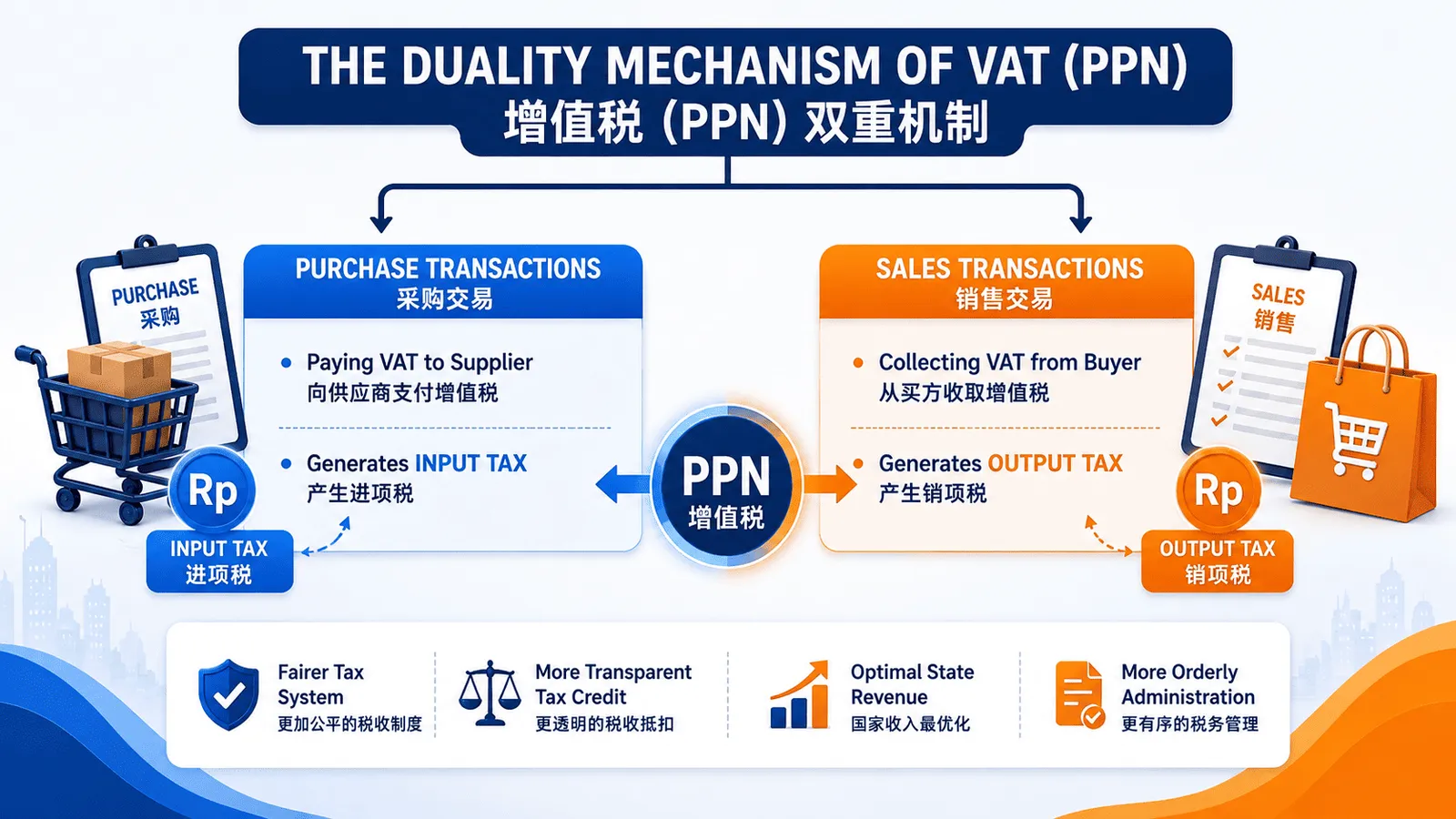
Input Tax is the VAT paid by a PKP when purchasing Taxable Goods or receiving Taxable Services related to business operations. Simply put, Input Tax arises on purchase/expenditure transactions.
Illustrative Example:
An electronics store purchases inventory from a distributor worth IDR 100,000,000. With a VAT rate of 11%, the store pays VAT of IDR 11,000,000 to the distributor. This IDR 11,000,000 amount becomes the Input Tax for the store.
If it meets legal qualifications, this Input Tax can be credited to reduce the VAT value that must be remitted to the state.
What Is Output Tax?
Output Tax is the VAT collected by a PKP when selling Taxable Goods or delivering Taxable Services to customers. This tax arises on sales/revenue transactions.
Illustrative Example:
The electronics store above then sells its merchandise to end consumers with a total value of IDR 150,000,000. With a VAT rate of 11%, the store collects VAT of IDR 16,500,000 from the sale. This IDR 16,500,000 amount is the Output Tax.
Output Tax has the status of a tax deposit from consumers that must be calculated and reported by the PKP.
Main Differences & How to Calculate the VAT Difference
The easiest difference to measure is based on the company's position in a transaction chain:
Simulation of VAT Difference Calculation
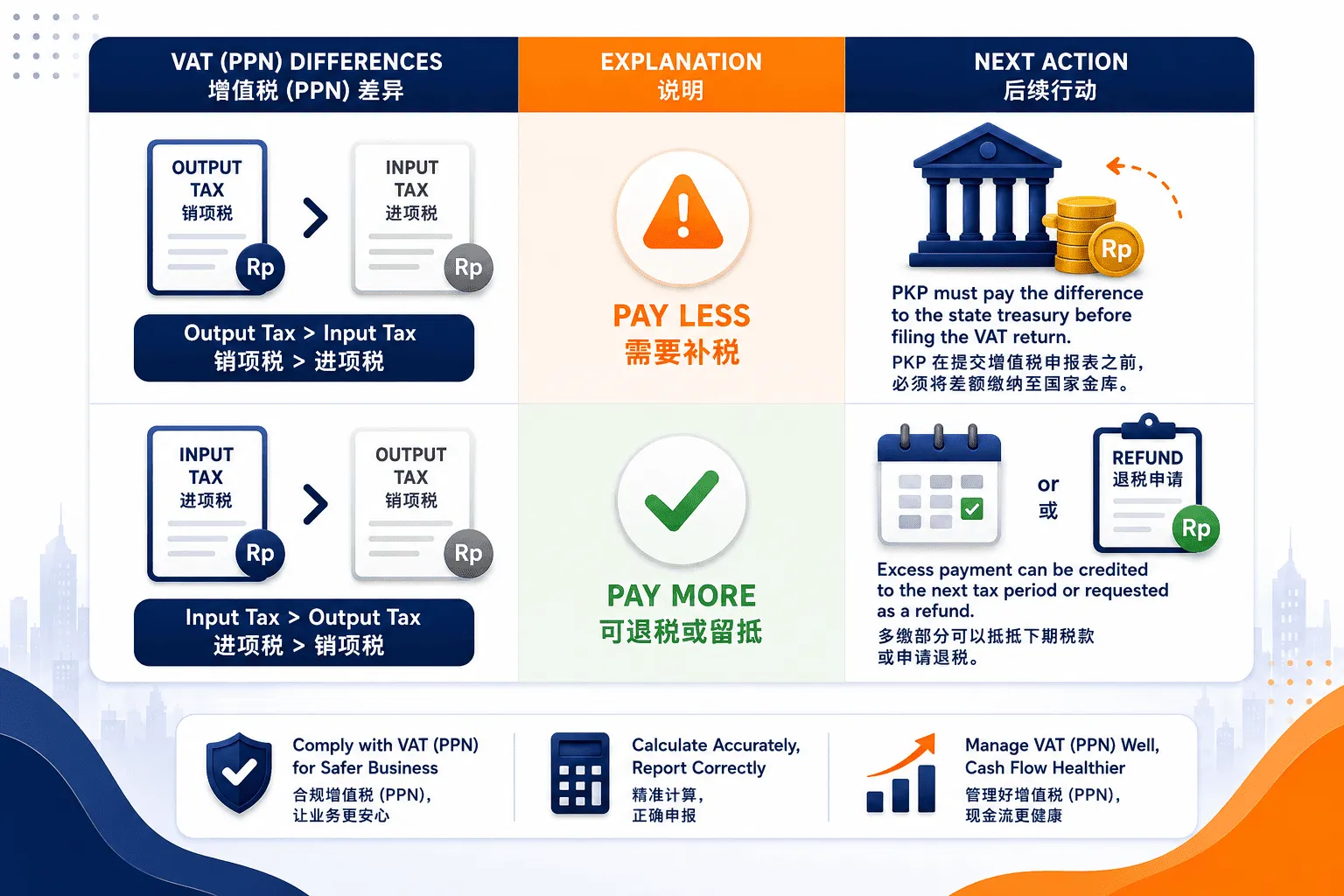
Continuing the PT ABC example above, the company does not need to remit the entire Output Tax of IDR 16,500,000 to the state treasury. The calculation is as follows:
- Output Tax (Sales): IDR 16,500,000
- Input Tax (Purchases): IDR 11,000,000
- VAT Payable (Must Be Remitted): IDR 5,500,000 (IDR 16,500,000 - IDR 11,000,000)
Legal Requirements for Input Tax Crediting
Input Tax cannot be credited automatically. Based on applicable tax regulations, crediting is only valid if it meets the following criteria:
- Has a Valid Tax Invoice: Supported by an electronic Tax Invoice (e-Faktur) legally issued by the supplier.
- Directly Related to Business Activities: The purchase of goods or services must be intended for production, management, marketing, or commercial operational activities of the company.
- Within the Crediting Time Limit: Conducted in accordance with periodic tax reporting procedures.
If the Input Tax Invoice is defective or not directly related to business activities, the VAT value cannot be credited and will add to operational cost burdens.
Periodic VAT Return (SPT Masa PPN) Reporting and Administrative Sanctions
Every business that has PKP status has an obligation to submit a Periodic VAT Return (SPT Masa PPN) every month.
- Reporting Deadline: No later than the end of the following month after the relevant tax period ends.
- Late Penalty: Late submission of the Periodic VAT Return is subject to an administrative fine of IDR 500,000 for each tax period, even if the report has zero activity.
Therefore, neat recording of Input and Output Tax Invoices is the key to avoiding penalty fines.
VAT provisions in Indonesia are based on Law Number 42 of 2009, which has been updated through Law Number 7 of 2021 concerning Harmonization of Tax Regulations (UU HPP), as well as implementing regulations such as PMK Number 131 of 2024 and PMK Number 11 of 2025.
To date, the general VAT rate applicable to most transactions of goods/services is 11%, while the 12% rate is focused on the delivery of luxury goods subject to PPnBM.
FAQ About Input Tax and Output Tax
Can all Input Tax be credited?
No. Input Tax can only be credited if supported by a valid Tax Invoice and used for business purposes directly related to business operations.
What if the company's Input Tax is greater than Output Tax?
An Overpayment condition will occur. This VAT overpayment can be compensated to reduce VAT obligations in the following month or submitted for a refund restitution application.
Can a Sole Proprietorship PT credit Input Tax?
Yes, as long as the Sole Proprietorship PT entity has been officially confirmed as a PKP by the local Tax Office.
Integrated Tax Management with Awan Kusuma Legalitas
Managing e-Faktur and ensuring Periodic VAT Return compliance requires precision to avoid administrative penalty fines.
The Awan Kusuma Legalitas consultant team is ready to help your business entity manage legality and tax compliance accurately, starting from the PT Establishment process, NIB management, PKP confirmation assistance, to Annual SPT reporting consultation.
Want to consult about VAT crediting or PKP status processing for your business? Contact the Awan Kusuma Legalitas Team via WhatsApp now for professional handling from our consultants!